Walk into UNC Campus Health with a health concern, and you’re walking into a level of care that most universities simply don’t offer their students.
Campus Health is one of 10 student health centers in the country accredited by the Joint Commission — the same gold-standard accrediting body that evaluates the nation’s hospitals. It’s a distinction the organization has held for 40 years, and one that speaks to a commitment to quality that stretches back even further.
For over 100 years, Campus Health has been one of the most valuable resources on Carolina’s campus. Now, as it prepares to enter its next chapter, that legacy is worth looking back on — and forward to.
Over a Century of Care


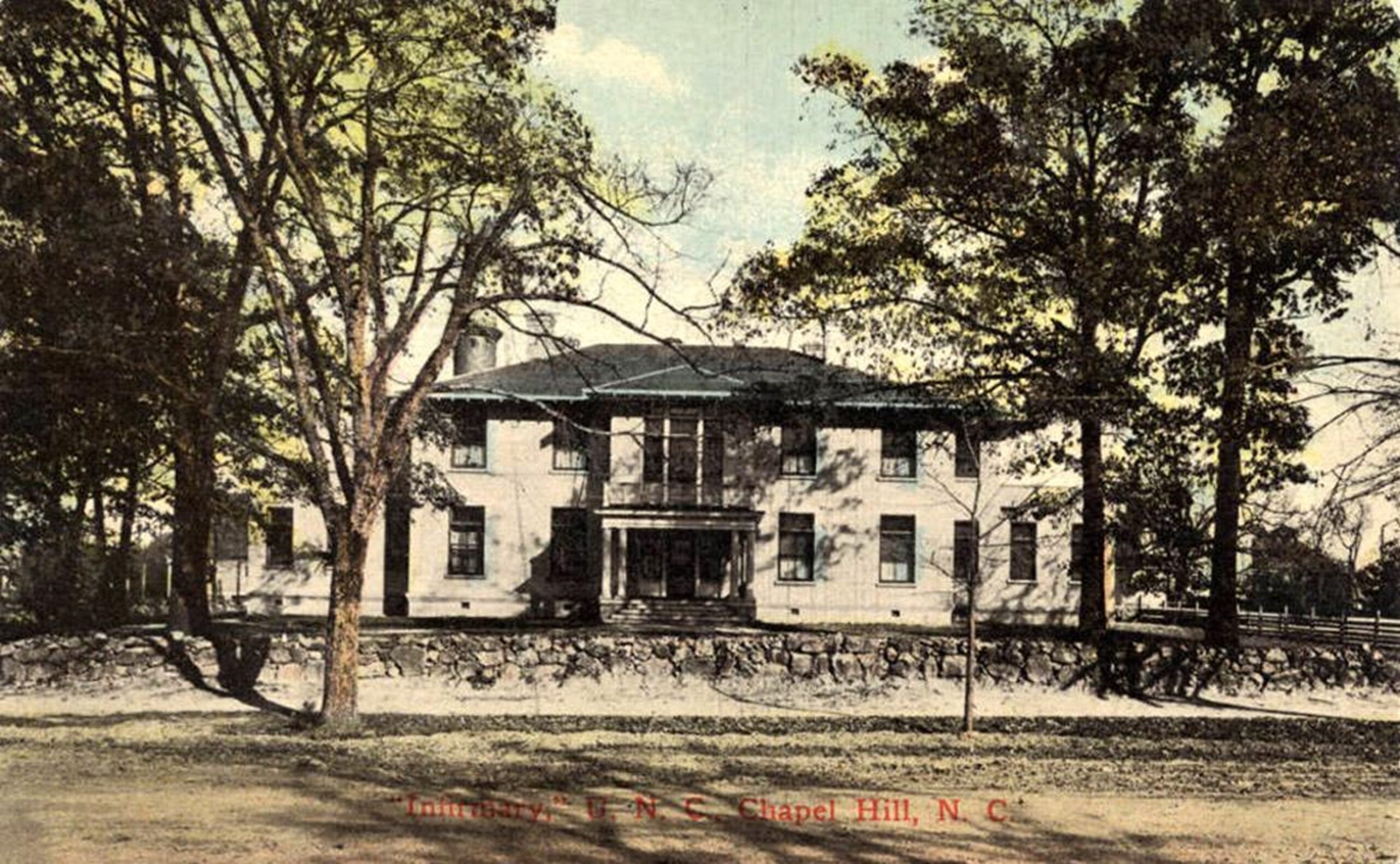
The University’s commitment to student wellbeing began with something modest: a two-room infirmary called “the Retreat,” completed around 1858 behind the Episcopal church on Franklin Street — the last structure built by UNC-Chapel Hill before the Civil War. Over the following decades, the University’s approach grew steadily. In 1891, students began paying an annual infirmary fee of $5, an early model of what we might today call the student health fee, which entitled them to medical care at no further charge.
With that income, and with the generous contribution of Harry S. Lake, a student from New York City, Carolina built a new three-room infirmary in 1895 near the present site of Hill Hall Auditorium. It was run by Dr. Richard H. Whitehead, who had arrived at the University in 1890 as the first dean of the UNC School of Medicine.
By 1907, that building had given way to a more ambitious structure: a third infirmary on South Columbia Street, built for $21,000 and large enough to accommodate 20 patients. It contained what was described at the time as a “modernly” equipped operating room — a signal that the University was beginning to take student health care more seriously. The building would later be named Abernethy Hall, in honor of Dr. E.A. Abernethy, who cared for summer school patients there until he left to serve in World War I.
When Dr. Abernethy returned from the war, the University made a decision that would shape everything that followed. In 1920, the Board of Trustees appointed him as the first University physician, placing him in sole charge of the infirmary and giving the institution a dedicated leader for student health for the very first time.
The timing was not coincidental. The influenza epidemic of 1918-1919 exposed the fragility of campus health infrastructure — and the vulnerability of students to large-scale public health crises. The war years had also revealed something troubling closer to home: a significant number of North Carolinians had been rejected by the Draft Board due to preventable health problems, drawing wider attention to the inadequacies of local health care. The University paid attention. Alongside Abernethy’s appointment, Carolina also took steps to improve its athletic programs, intramural sports, and campus sanitation. Student health, in other words, was becoming a campus-wide priority and proactive commitment.
After outgrowing that facility, construction was completed in 1980 on what is now the James A. Taylor Student Health Services Building – named for one of its most transformative directors. A Carolina undergraduate alumnus, Harvard-trained physician, and Bronze Star recipient, Dr. Taylor led the health service from 1971 to 1981, guiding it through one of the most turbulent periods in University history. During his tenure he witnessed sweeping changes in the student body — including a sexual revolution, the admission of women in large numbers, and a fundamental shift in how students understood their own rights — and helped shape a health service capable of meeting students where they were.
It was shortly after settling into that building that Campus Health achieved the distinction it holds to this day. Beginning in 1986, the organization earned accreditation from the Joint Commission — the same gold-standard body that accredits the nation’s hospitals. It is a designation that Campus Health has maintained for 40 consecutive years, a testament to a standard of care that defined the organization across every decade of its first century.
Breadth of Services at Campus Health
Campus Health today operates as a full-service health center in every sense. Its services span mental health and counseling, two pharmacies, laboratory and diagnostic services, sexual health and reproductive care, allergy and immunization services, physical therapy, nutrition counseling, and telehealth — equipping the organization to serve students through acute illness, chronic condition management, and the sustained work of staying well. Campus Health also serves as the on-campus public health department for students through a formal partnership with the Orange County Health Department, providing communicable illness case management and ensuring compliance with state-required immunizations. When medical or mental health challenges begin affecting students academically, Campus Health works alongside faculty and administrators to coordinate the interventions students need to stay on track.
Perhaps less widely known is Campus Health’s role in varsity athletics. Campus Health maintains an NCAA-designated best practice independent medical model — one of only a handful of programs in the country to do so — in which care for varsity athletes is overseen by a healthcare organization rather than Carolina Athletics. The result is a model built around athlete health and wellbeing, free from the pressures that can complicate that care elsewhere. And every Carolina student, varsity athlete or not, has access to the same providers and the same standard of care.
College students today face a demanding set of health challenges: the stress of academic pressure, the mental health struggles that often surface for the first time in young adulthood, the need for accessible and judgment-free sexual health care, and the challenge of managing chronic conditions far from home for the first time. Campus Health has built its services around those realities. The data speaks for itself: Campus Health is an in-network provider for 94% of students’ health insurance plans and over 75% of Carolina students use Campus Health every academic year. They do so with the assurance of Joint Commission accreditation, meaning they receive the same standard of care they would expect at any top-tier medical facility.
The Next Chapter
Over a century in, Campus Health is preparing for what may be its most significant transition yet. In the coming months, Campus Health will be integrated into UNC Health, the state’s flagship academic health system. The integration is designed to strengthen Campus Health’s capabilities — expanding access to specialists, resources, and technology that come with being part of a major health system — to best meet the health needs of Carolina students and post-doctoral fellows.
UNC Health offers a statewide network of 20 hospitals, more than 900 clinics, and clinical patient care programs at the UNC School of Medicine, providing a depth of specialized expertise and resources that will enhance continuity of care for students on campus and across North Carolina. As an academic health system, UNC Health draws on state-of-the-art research and evidence-based care developed by Carolina’s leading medical school faculty, ensuring students benefit from the latest advances in clinical practice and innovation. Students can expect seamless continuity in care, with clinicians dedicated to supporting students before, during and after their time at UNC-Chapel Hill.
In some ways, the move echoes an earlier chapter in Campus Health’s history. In 1952, when North Carolina Memorial Hospital absorbed the infirmary’s building, Campus Health adapted — trading space for access to hospital staff and ultimately emerging stronger for it. The coming integration with UNC Health is, in that sense, a continuation of that legacy — an organization following a well-worn instinct to adapt in service of the students it was built to serve.
What began as a two-room retreat behind a Franklin Street church has grown into one of the most rigorously accredited student health centers in the country. The next chapter is still being written — but if the first hundred years are any indication, it will be written with the same commitment to quality that has defined Campus Health from the beginning.